An R toolkit for quality assessment of reverse correlation (RC) classification images. It bundles per-face-region infoval() analyses and cross-producer agreement maps across the face (both descriptive and FWER-controlled inferential tests) into one workflow, for 2IFC (Dotsch, 2016) and Brief-RC (Schmitz, Rougier & Yzerbyt, 2024) designs.
Package is not on CRAN, distribution is GitHub-only.
User guide · Installation · Using rcisignal on a real data set · Citation
Installation
From GitHub:
# install.packages("remotes")
remotes::install_github("olivethree/rcisignal")
If you ran a 2IFC study, you will also need rcicr (used to compute the individual CIs):
remotes::install_github("rdotsch/rcicr")Brief-RC users can skip rcicr; the Brief-RC code is fully native to rcisignal.
Re-install before each fresh analysis.
rcisignalis in an experimental stage and exported functions are still being refined. Re-runningremotes::install_github("olivethree/rcisignal")at the start of an analysis session pulls the latest version; the user guide is kept in sync with new and updated functions.
Using rcisignal on a real data set
A re-analysis of the open data from Oliveira, Garcia-Marques, Dotsch & Garcia-Marques (2019), 2IFC reverse correlation on a 256 x 256 grayscale male base face, target mental represeations are social traits (e.g. trustworthy,competent, friendly), 20 producers per trait, 300 trials per session. Data collected in a lab setting.
Cross-producer agreement maps
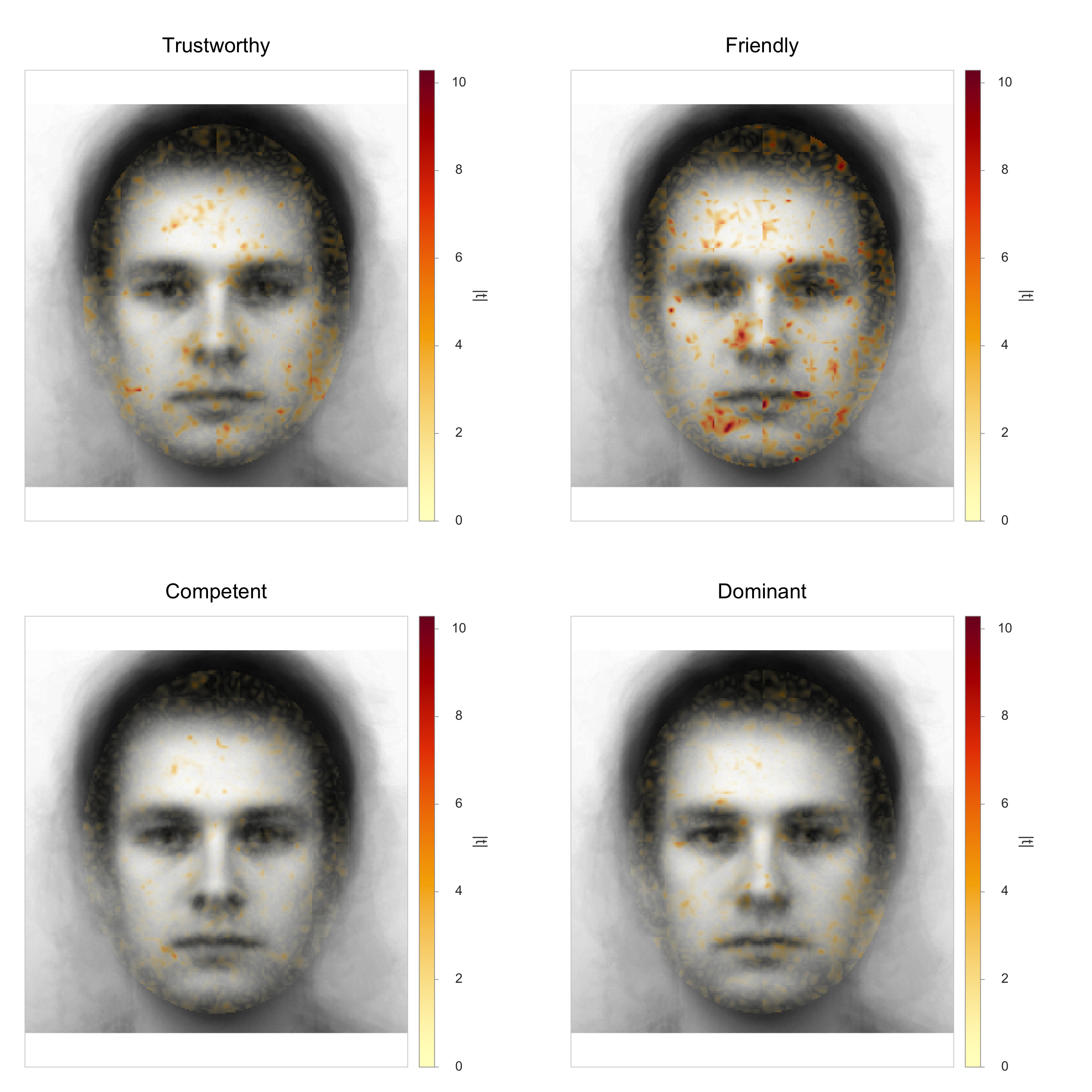
For each trait, brighter pixels mark image regions where the 20 producers in the RC task agreed more strongly on the location of the target representation in their perception. The colorbar shows the degree of agreement (|t|) from a per-pixel one-sample test of producer CIs against zero, computed within the full-face oval mask applied to the base face image. Hot regions indicate consistent across-producer structure regardless of sign; pale regions indicate weak or inconsistent agreement. For the directional view (where the signal sits above or below the base), see the user guide.
infoval() per face region
Per (trait, region) cell. Values are the median producer z-score and (in parentheses) the number of producers (out of 20) clearing z >= 1.96, using face-region masks and a trial-count-matched reference distribution.
| Trait | Full face | Upper face | Eyes | Mouth |
|---|---|---|---|---|
| Trustworthy | +0.50 (3/20) | +0.30 (2/20) | +0.50 (1/20) | +0.53 (3/20) |
| Friendly | +0.97 (5/20) | +0.23 (2/20) | +0.34 (2/20) | +0.75 (4/20) |
| Competent | +0.70 (3/20) | +0.21 (3/20) | +0.36 (2/20) | +0.25 (5/20) |
| Dominant | +0.89 (6/20) | +0.37 (5/20) | +0.91 (3/20) | +0.38 (2/20) |
The user guide walks through every exported function, the interpretation of these maps and the per-region grid, and the full Worked example: Oliveira et al. (2019), Study 1 section.
Validation status
Several metrics in this package are package-level extensions whose behavior on social perception-related RC data has not been independently validated. See §1.2 Validation status in the user guide for the breakdown of validated versus unvalidated metrics, and treat the unvalidated ones as exploratory in published work. The rcisignal vs rcicr vignette has the engine-equivalence receipts for the per-producer 2IFC infoVal claim and a Brief-RC signal-recovery sanity check.
Citation
If rcisignal helps your research, please cite it:
Oliveira, M. (2026). rcisignal: Quality checks for reverse-correlation data and classification images (Version 0.3.1) [R package]. Zenodo. https://doi.org/10.5281/zenodo.19961180
Run citation("rcisignal") in R for a BibTeX entry.
Please also cite the methodological sources appropriate to your pipeline:
-
2IFC: Dotsch (2016, 2023) for the
rcicrpackage; Brinkman et al. (2019) for infoVal. - Brief-RC: Schmitz, Rougier, and Yzerbyt (2024).
References
- Brinkman, L., Goffin, S., van de Schoot, R., van Haren, N. E. M., Dotsch, R., & Aarts, H. (2019). Quantifying the informational value of classification images. Behavior Research Methods, 51(5), 2059-2073. https://doi.org/10.3758/s13428-019-01232-2
- Dotsch, R. (2016, 2023). rcicr: Reverse-correlation image-classification toolbox [R package]. https://github.com/rdotsch/rcicr
- Oliveira, M., Garcia-Marques, T., Dotsch, R., & Garcia-Marques, L. (2019). Dominance and competence face to face: Dissociations obtained with a reverse correlation approach. European Journal of Social Psychology. https://doi.org/10.1002/ejsp.2569
- Schmitz, M., Rougier, M., & Yzerbyt, V. (2024). Introducing the brief reverse correlation: An improved tool to assess visual representations. European Journal of Social Psychology. https://doi.org/10.1002/ejsp.3100
License
Released under the MIT License.
Credits
Designed by Manuel Oliveira 
Code and documentation were co-built with Claude (Opus 4.6, Anthropic; April-May 2026).
Acknowledgements to the community
This package builds on the excellent foundational work by Ron Dotsch, Loek Brinkman, Alex Todorov, Mathias Schmitz, Marine Rougier, Vincent Yzerbyt, and their many collaborators across the years. Reverse correlation is no longer a central part of my research, but I still find a lot of enjoyment in working on these side projects. The inspiration to build these tools and tutorials comes mostly from occasional collaborations with my PhD supervisors (Teresa Garcia-Marques, Leonel Garcia-Marques) and all the warm and competent colleagues from the research groups in Lisbon (Goncalo Oliveira, Rui Costa-Lopes and their teams) with whom I have been greatly enjoying working together on this stuff. Hopefully this toolkit will come in handy to all the RC research enthusiasts out there! :)